


Chambers Dictionary Of Scientists
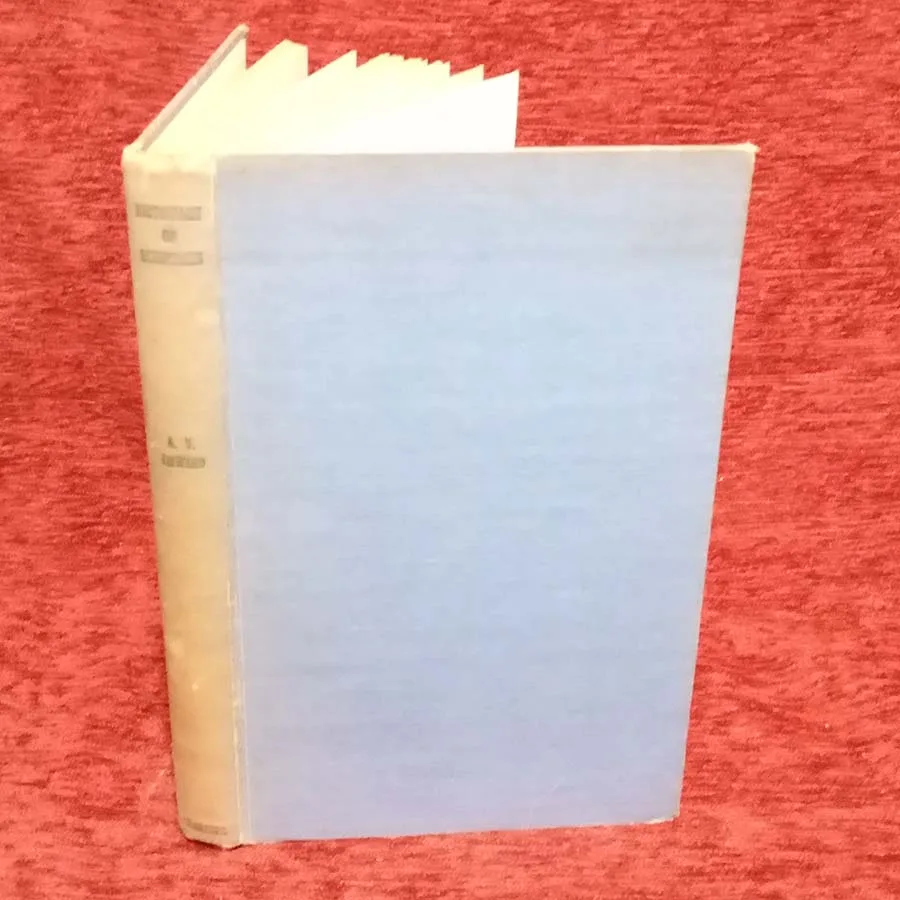
Publisher: McCorquodale
Format: Hardback
ISBN: none
Ah, Chambers Dictionary of Scientists (1951) by A. V. Howard: a book from that noble tradition of reference works which assumed, quite reasonably, that the reader might one day need a brisk and authoritative account of a chemist, astronomer, anatomist, physicist, botanist or miscellaneous genius, and would prefer not to rely on vague memory, pub folklore, or whatever nonsense a modern search engine decides to place at the top.
Published in 1951 by McCorquodale, this is a post-war monument to organised intelligence: a compact republic of brains in alphabetical order. Here are the men and women who measured, classified, exploded, observed, dissected, theorised, peered, calculated and generally interfered with the universe until it reluctantly gave up some of its secrets. Some changed the world. Some changed one small technical corner of it. All were apparently important enough to be granted entry into this printed parliament of the scientifically inclined.
There is something deeply satisfying about a dictionary of scientists. It combines two reassuring ideas: first, that knowledge can be sorted alphabetically, and second, that human progress may be understood by consulting a stout book. No passwords, no updates, no loading wheel, no cheerful little box asking whether you accept cookies. Just paper, print, and a determined attempt to summarise the history of enquiry one biographical entry at a time.
And what a world it evokes. This was published in 1951, when science still carried a particular sort of public dignity: white coats, brass instruments, serious lectures, blackboards full of symbols, and the lingering national hope that sufficiently intelligent people might eventually fix everything. Atomic age optimism was in the air, though so too was the memory of what science, in less comforting hands, could also do. A dictionary like this belongs to that moment — respectful, orderly, and faintly heroic in tone, as if the scientific enterprise were a grand relay race conducted by unusually clever people with alarming handwriting.
Of course, any older scientific reference book now carries a delightful secondary charm. It is not merely a guide to scientists; it is itself an artefact of how science was once presented. Who was included, how they were described, what was emphasised, and what was left out — all this gives the modern reader an extra layer of interest. You are not just reading about discovery; you are glimpsing the mid-century mind arranging discovery into tidy printed form and assuming, with admirable confidence, that this would be useful for decades.
This copy is in Good condition, which is exactly what one wants from a serious old reference book. It has survived the long march from post-war bookshelf to present-day obscurity without collapsing into scholarly dust. One imagines it spending years in a study, a school, a provincial library, or the house of a person who thought it sensible to know who Lavoisier was. And they were right.
There is also a certain understated comedy in the title. Dictionary of Scientists sounds calm and procedural, but what it really contains is a gallery of obsessives: people who stared at the heavens, boiled dangerous substances, named tiny things, split invisible things, argued over principles, and devoted years of life to proving points that most of us would not understand even if explained slowly with diagrams. Humanity’s great advance, it turns out, was built largely by individuals who refused to leave well enough alone.
Naturally, in the age of instant information, a volume like this seems almost quaint. Why keep a 1951 dictionary of scientists when one could tap at a screen and be distracted within six seconds by something unrelated about space lasers or celebrity diets? Because this has the old virtues: authority, selectiveness, and the quiet pleasure of stumbling across people you did not know existed. It invites browsing, not merely searching. You open it for Newton and emerge half an hour later having acquired opinions about an eighteenth-century mineralogist.
So here it is: a sturdy mid-century biographical compendium of the world’s more industrious minds, now residing in Good condition and offered by Crappy Old Books, where the grand project of civilisation occasionally reappears between faded jackets and slightly foxed endpapers.
A dictionary of scientists.
Which is really a dictionary of humanity’s most determined meddlers with reality.
And thank heavens for that.
Keep browsing: See more Academic books Other books by AV Howard
